
Exercise guides
Front Raise vs Lateral Raise vs Y Raise: Which Delt Each One Trains (+ Chart)
Reviewed by the Crucible Fit team · Updated November 4, 2026 · 7 min read
Front raises train the front delts, lateral raises train the side delts, and Y raises train the side and rear delts along with the lower traps. Pressing already works the front delts hard, so for most people the lateral raise and the Y raise do more for shoulder width and shoulder health.
Each raise comes in dumbbell, cable and ring versions. Dumbbells are simplest, cables keep tension at the bottom of the rep, and rings turn the raise into a core exercise too. The chart shows where each one lands on the shoulder.
Key takeaways
- Front raise: front delts. Lateral raise: side delts. Y raise: side and rear delts plus lower traps.
- If you press regularly, your front delts already get plenty; prioritise lateral and Y raises.
- Cables keep tension at the bottom of the rep, where dumbbells go slack.
- Ring versions add a plank, so they train the core at the same time.
- Use light weights and push the load out, not up.
Which delt each raise trains
1 = front delts, 5 = rear delts and lower traps
- Dumbbell front raiseWhere the work lands: 1 of 5
Almost all front delt.
- Cable front raiseWhere the work lands: 1 of 5
Front delt, with tension from the very start.
- Ring front raiseWhere the work lands: 1 of 5
Front delt plus a hard plank for the core.
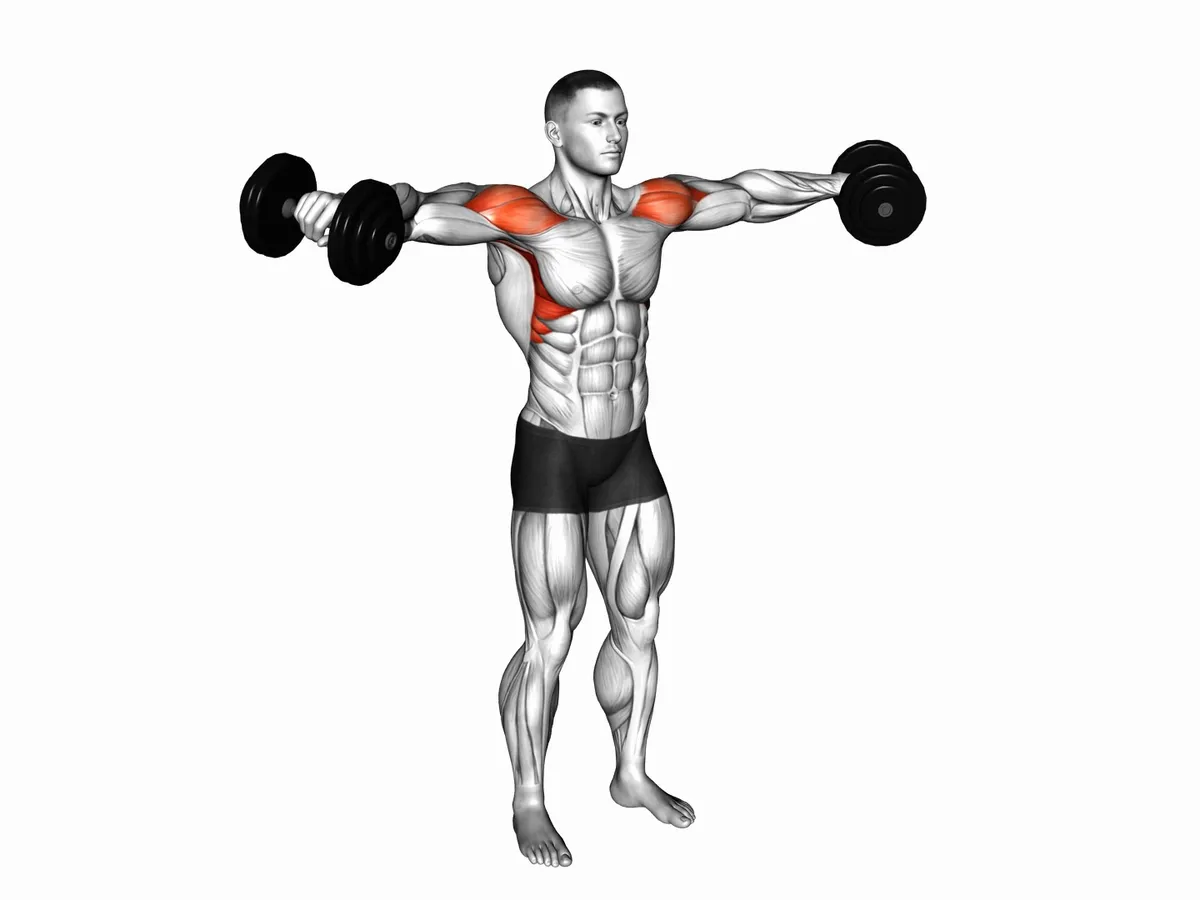
- Dumbbell lateral raiseWhere the work lands: 3 of 5
Side delt, the main driver of shoulder width.
- Cable lateral raiseWhere the work lands: 3 of 5
Side delt, loaded where it's stretched.
- Super-ROM lateral raiseWhere the work lands: 3 of 5
Side delt through to overhead, with the upper traps.
- Incline Y raiseWhere the work lands: 4 of 5
Side and rear delts and lower traps, chest supported.
- Cable Y raiseWhere the work lands: 4 of 5
Side and rear delts and lower traps, with constant tension.
- Ring Y raiseWhere the work lands: 4 of 5
Rear delts and lower traps plus a body-weight plank.
How the raises compare
| Variation | Main muscles | Equipment | Difficulty | Best for | Load potential |
|---|---|---|---|---|---|
| Dumbbell front raise | Front delts | Dumbbells | Beginner-friendly | Front delts if you rarely press | Light to moderate |
| Cable front raise | Front delts | Cable stack, bar | Beginner-friendly | Tension from the start | Light to moderate |
| Ring front raise | Front delts, core | Rings or straps | Intermediate | Shoulders and core together | Bodyweight |
| Dumbbell lateral raise | Side delts | Dumbbells | Beginner-friendly | Shoulder width | Light |
| Cable lateral raise | Side delts | Cable stack | Intermediate | Loading the stretched position | Light |
| Super-ROM lateral raise | Side delts, upper traps | Dumbbells | Intermediate | Full range to overhead | Light |
| Incline Y raise | Side and rear delts, lower traps | Dumbbells, incline bench | Beginner-friendly | Posture and shoulder health | Very light |
| Cable Y raise | Side and rear delts, lower traps | Two low cables | Intermediate | Constant tension | Light |
| Ring Y raise | Rear delts, lower traps, core | Rings or straps | Intermediate | Home training | Bodyweight |
Raises are accessories. They work best after a press and a row, covered in our guides to shoulder press variations and types of rows.
Front raises
Dumbbell front raise
Holding dumbbells in front of your thighs, you raise them straight ahead to shoulder height. It isolates the front delts. If you already bench or overhead press, they're well trained, and this one is optional.
- Keep your torso still and a slight bend in the elbows.
- Push the dumbbells toward the wall in front, stopping at shoulder height.
- Switch to a neutral grip if the shoulder pinches.
Common mistake: rocking back to swing the weight up. Full setup: dumbbell front raise.
Cable front raise
Facing away from a low pulley with the cable between your legs, you raise a bar to shoulder height. Unlike dumbbells, the cable pulls back from the first inch, so the bottom of the rep does work too.
- Step forward to take up the slack before the first rep.
- Keep your shoulders down and back so the traps stay quiet.
- Stop at shoulder height.
Common mistake: leaning back as the set gets hard. Full setup: cable front raise.
Ring front raise
Facing away from the anchor, you lean into the rings in a plank and raise your straight arms overhead. Your bodyweight is the load, and your core has to stop your back from arching, so it's as much an anti-extension core drill as a shoulder raise.
- Ribs down, glutes tight, straight line from head to heels.
- Move only at the shoulders; keep the elbows straight.
- Stand more upright to make it easier.
Common mistake: letting the lower back sag as the arms go overhead. Full setup: ring front raise.
Lateral raises
Dumbbell lateral raise
Dumbbells at your sides, you raise them out to shoulder height. The side delts give the shoulders their width, and pressing barely trains them, so this is the raise most worth doing. Light weights with strict reps beat heavy swinging.
- Lean forward slightly and keep a fixed bend in the elbows.
- Push the weights out toward the side walls, leading with the elbows.
- Stop at shoulder height and keep the traps relaxed.
Common mistake: shrugging the weight up with the traps. If your shoulders rise toward your ears, go lighter. Full setup: dumbbell lateral raise.
Cable lateral raise
Standing side-on to a low pulley, you raise the handle across and out with the far arm. The cable loads the bottom of the rep, where the side delt is stretched and a dumbbell weighs almost nothing. Leaning away from the machine increases that stretch.
- Hold the machine with your near hand and lean slightly away.
- Keep the arm a little in front of your body, not directly to the side.
- Keep the wrist firm and stop at shoulder height.
Common mistake: pulling with the arm instead of lifting with the shoulder. Full setup: cable lateral raise.
Super-ROM lateral raise
A lateral raise that keeps going past shoulder height until the dumbbells meet overhead. The extra range brings in the upper traps and asks the shoulder blades to rotate upward. Use a lighter weight than for a standard lateral raise.
- Start with the dumbbells slightly in front of your hips.
- Keep the elbows slightly bent and fixed through the whole arc.
- Let the shoulder blades rotate naturally as the arms pass shoulder height.
Common mistake: leaning back to get the weight overhead. Full setup: dumbbell super-ROM lateral raise.
Y raises
Incline dumbbell Y raise
Lying face down on an incline bench, you raise light dumbbells up and out into a Y, thumbs up. The bench removes all momentum, and the movement trains the lower traps, which help control the shoulder blades during pressing. Expect to use very light weights.
- Keep your chest on the bench and your thumbs pointing up.
- Reach long toward the corners of the room, not just up.
- Start the lift by drawing the shoulder blades down.
Common mistake: going too heavy and shrugging. Full setup: dumbbell incline Y raise.
Cable Y raise
Standing between two low pulleys with the cables crossed, you raise both handles up and out into a Y. The cables keep tension on the side and rear delts the whole way, which makes it a strong finisher.
- Cross the cables: left hand takes the right handle, right hand the left.
- Lean slightly forward from the hips and keep a fixed elbow bend.
- Keep the shoulders down throughout.
Common mistake: leaning back to swing the handles up. Full setup: cable Y raise.
Ring Y raise
Facing the anchor and leaning back on straight arms, you pull yourself up by spreading the rings into a Y. It's a hard rear-delt and lower-trap exercise using only bodyweight, which makes it ideal at home. Walking your feet back makes it easier.
- Keep a straight line from head to heels.
- Pull the rings apart as you raise them.
- Keep your wrists neutral; don't curl the rings in.
Common mistake: swinging the hips to start the rep. Full setup: ring Y raise.
How to program shoulder raises
- Do raises after your presses and rows, for 2 to 4 sets of 10 to 20 reps.
- Prioritise lateral raises for width and Y raises for shoulder health. Front raises are optional if you press.
- Progress with reps and slower lowering before adding weight; small jumps matter on raises.
- Rest briefly, 45 to 90 seconds. Raises recover quickly.
Crucible Fit fits accessories like these around the main work. Every Crucible comes in bodyweight, dumbbell and kettlebell versions, and it raises your rep targets as you improve. Your first Crucible is on us: get Crucible Fit on the App Store.
Frequently asked questions
- Should I do front raises or lateral raises?
- Lateral raises, for most people. Pressing already trains the front delts hard, while the side delts get little work from pressing and give the shoulders their width. Add front raises only if you rarely press.
- What does a Y raise work?
- The side and rear delts and the lower traps. The lower traps help control the shoulder blades when you press overhead, which is why Y raises are popular for shoulder health.
- Are cable lateral raises better than dumbbell lateral raises?
- Cables load the bottom of the movement, where dumbbells go slack, so they challenge the side delt in its stretched position. Both work. Use whichever you have, or do one of each.
- How heavy should lateral raises be?
- Light enough to raise to shoulder height without shrugging or swinging, for 10 to 20 reps. For most people that's far lighter than they expect.
- What is a super-ROM lateral raise?
- A lateral raise that continues past shoulder height until the dumbbells meet overhead. It trains the side delts through a longer range and brings in the upper traps.